A primer on Regenerative Practice


Imagine one of your following relationships:
long term romantic life-partner
a best friend
your dearest family member
parent/guardian
pet
If someone asked how your relationship is going, and you say
“it’s sustainable”
It would set off alarm bells.
No one wants a relationship that is just sustainable, I hope.
I want relationships that are beautiful, expansive, vibrant, nourishing and reciprocal.
Relationships may not be like this all the time,
but,
aiming for only sustainable in our relationships
doesn’t make much sense.
Whether it is the relationship with ourself
Our colleagues, parents, siblings, co-workers, friends, the neighbour across the road,
the parklands, the forests, the oceans, our planet
Why are we just aiming for sustainable?
REGENERATION
A process that creates more life
A value-adding process that creates the conditions & catalysts for the ecology of a living system to be increasingly able to be vital, viable and evolve through cycles of decomposition & recombination
Reflexive Practice Question:
Looking back on a recent moment, event, or interaction.
How would you describe the quality of that interaction?
- regenerative? (reciprocal mutual benefit, which increases in quality and meaning over time and evolves the relationship and entities in the system over time - vitalising AND viabilising AND enabled evolution?)
- sustaining? (there was a degree of reciprocal benefit - it was vitalising AND viabilising?)
- extractive? (within an interaction value was exchanged, with no value-adding reciprocity within the large system - there is a degeneration in the whole system)
You may do this on an interaction from the past - this would be reflection
Over time, the aim is to make this reflexive, building the capacity to sense this within the moment, and calling on inner resources e.g. your vocation, to shift the interaction
How the "Regenerate Life" paradigm organises life to higher orders of complexity
Regeneration enables a whole living system to continually increase its vitality, viability and evolution - the system is able to exchange with higher orders of complexity.
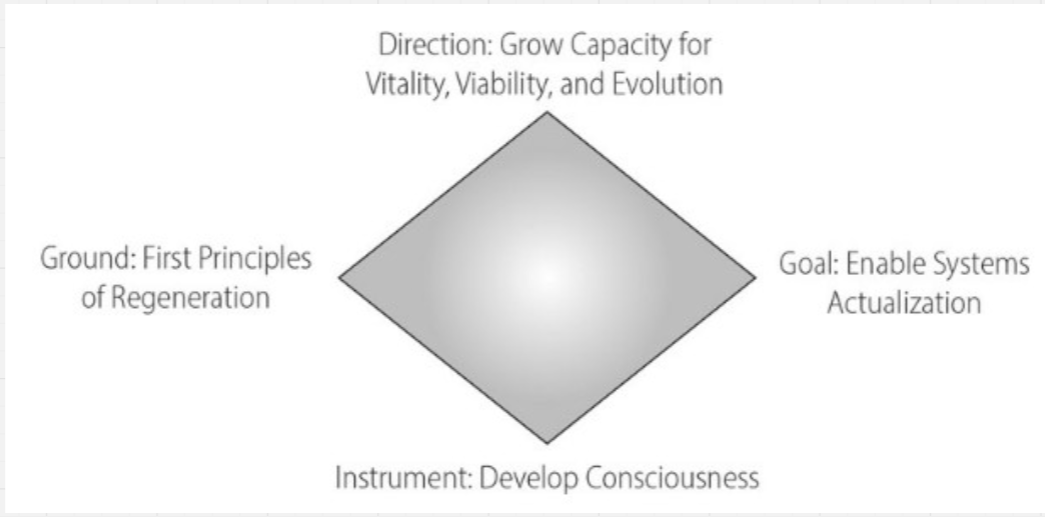
The Regenerative Life Tetrad - Carol Sanford
Think of the diversity and vitality within a rainforest compared to someone’s well manicured front lawn.
By understanding the culture of an ecological system (e.g. native plants and animals, and they type of "place") you can create the conditions for it to evolve towards higher orders of complexity.The difference on the overall ecosystem between planting some non-native trees together so that we have more of them, vs "Re-wilding" / restorative / regenerative processes for native ecosystems where you create the conditions for the system to evolve itself.


Written on Kaurna Yarta.
This land was stolen and First Nations Sovereignty was never ceded. I pay my respects to Kaurna Elders past and present. I acknowledge the continuing connection of First Nation's communities across the Earth to land, river, sea and sky.